
How to Search Lauderdale Cases by Name
The public Lauderdale County Online Court Records System puts Party Name and Case Reference into one box. Tackle one concept per search. Help text recommends a full first and last name. Only the first ten query words count.
- Select Circuit Court, General Sessions, or both, then select Criminal, Civil, or both.
- Enter the full party name or an exact case reference in the Party Name box.
- Keep “Match all search terms” checked for a focused first attempt.
- Complete the Cloudflare Turnstile check so Find Now activates.
- Submit, sort the result columns, and use the literal results Filter to narrow visible rows.
| Field Label | Type | Required | Notes |
|---|---|---|---|
| Party Name | Text, 100 characters | No | Accepts a full name or Case Reference, but use one concept. |
| Match all search terms | Checkbox | No | Checked by default and recommended first. |
| Court Type | Checkboxes | For court office | Circuit Court and General Sessions only. |
| Case Type | Checkboxes | For court office | Criminal and Civil only. |
Criteria stack, so extra values keep shrinking the Lauderdale County case lookup. Lean on the facts you trust most. A single wrong year can bury the right result.
Lauderdale Case Lookup Portal Fields
Five core criteria drive the form, according to the official TNCRTInfo Search Help: Party Name, Case Reference, Case Year, Case Number, and Court Office. Court Office is the court-type and case-type pair you pick. Case Year usually means the filing year, not the year of arrest, hearing, or disposition.
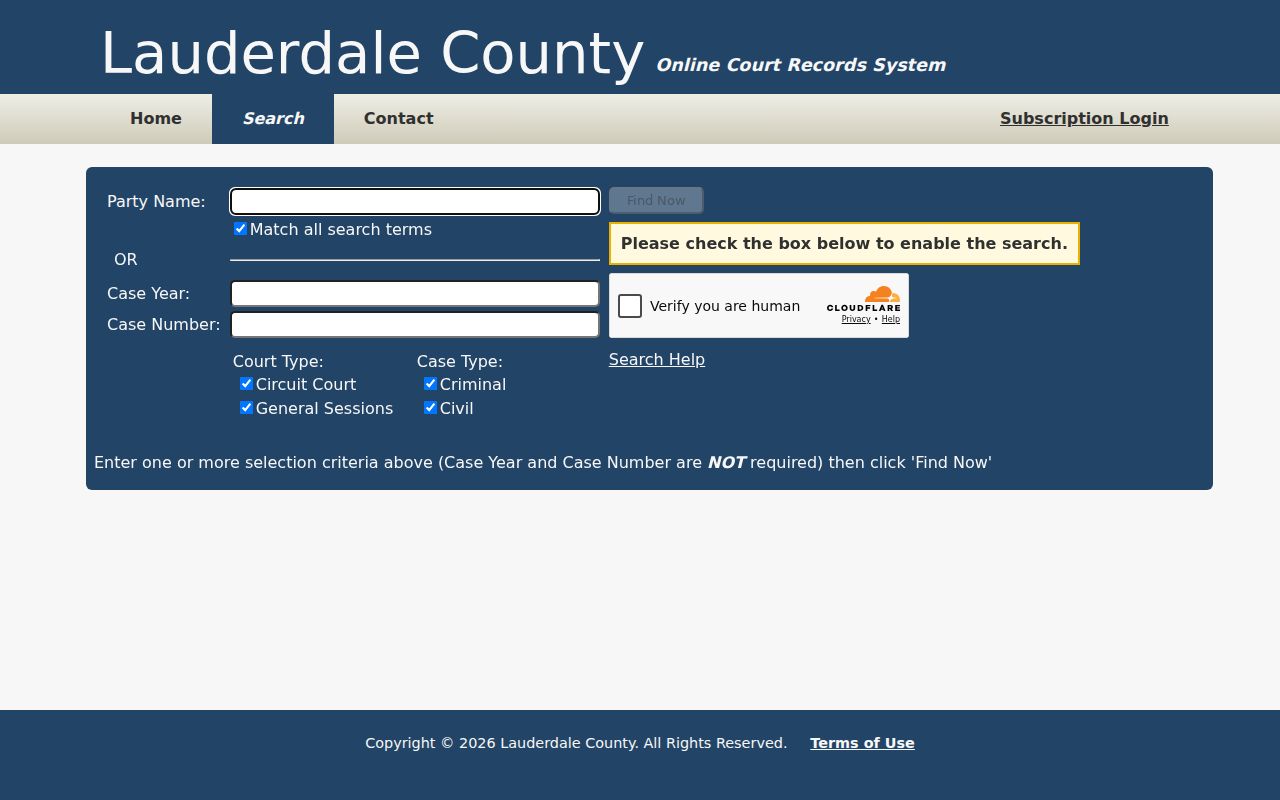
The help view shows why the court and case checkboxes work as search filters. They are not just display options. A year alone or a case number alone will run if paired with a court-office choice. Turnstile must pass before Find Now activates. That is an anti-bot check, not case data. The opening form offers no date range, judge, courtroom, attorney, export, or document-image control.
How to Search by Case Number
Never paste the full formatted reference into Lauderdale County's Case Number field. Take 99GS1-2023-CR-12345. The portal wants just 12345, the digits after the final hyphen. Pick the right court and case type. Then add the four-digit case year when you know it.
The front segments may hint at office, year, or case type. But the public field is built around that final number. This is a local interface rule, not a universal Tennessee format. Other clerks, appellate courts, and federal courts write their own references.
If the final segment returns nothing, recheck the court and case-type boxes. Try the filing year instead of an event year. Then contact the proper clerk before concluding the Lauderdale County case does not exist.
Lauderdale Name Matching Can Broaden
"Match all search terms" sounds strict, yet the documented logic bends. It starts with every term. Depending on how results behave, it can drop terms from the end and widen the net. Quotation marks force a phrase search. Soft separators get ignored. Hard separators split terms. Queries go lowercase with non-spacing marks stripped.
- Typo tolerance
- One typo for terms of at least five characters and up to two for terms of at least nine characters. Short names get no tolerance.
- Results Filter
- A literal filter over text already visible in returned columns. It is not a second database query.
- Row limit
- The maximum return is 2,500 rows. Narrow large sets with court, type, year, or final number.
Scan every column before opening a result. Alike names prove nothing, and a broad match never shows the records concern the same person or event.
What a Lauderdale Case Search Shows
A result row is a locator, nothing more. It can point to an indexed case and its public history. The full certified file may look different, since visible detail depends on the court, the case, and access rules.
| Case reference | The identifying number; the search field may need only its final numeric segment. |
|---|---|
| Parties or style | The caption or indexed names, subject to restriction and redaction. |
| Court and case type | Circuit or General Sessions paired with Criminal or Civil. |
| Filed year | The year first filed, which may differ from later event dates. |
| Docket events | Public filings, settings, orders, hearings, or dispositions when supplied. |
An entry can name an event yet omit the motion, pleading, exhibit, or order itself. Ask the clerk whether an item is open to inspection, sold as a plain copy, or sold certified. Lauderdale court-copy fees are not published in official sources, so request a current estimate.
Lauderdale Search Starts With Filters
The blank official Lauderdale case-search form is the safest way to see the live controls without exposing any private party record.
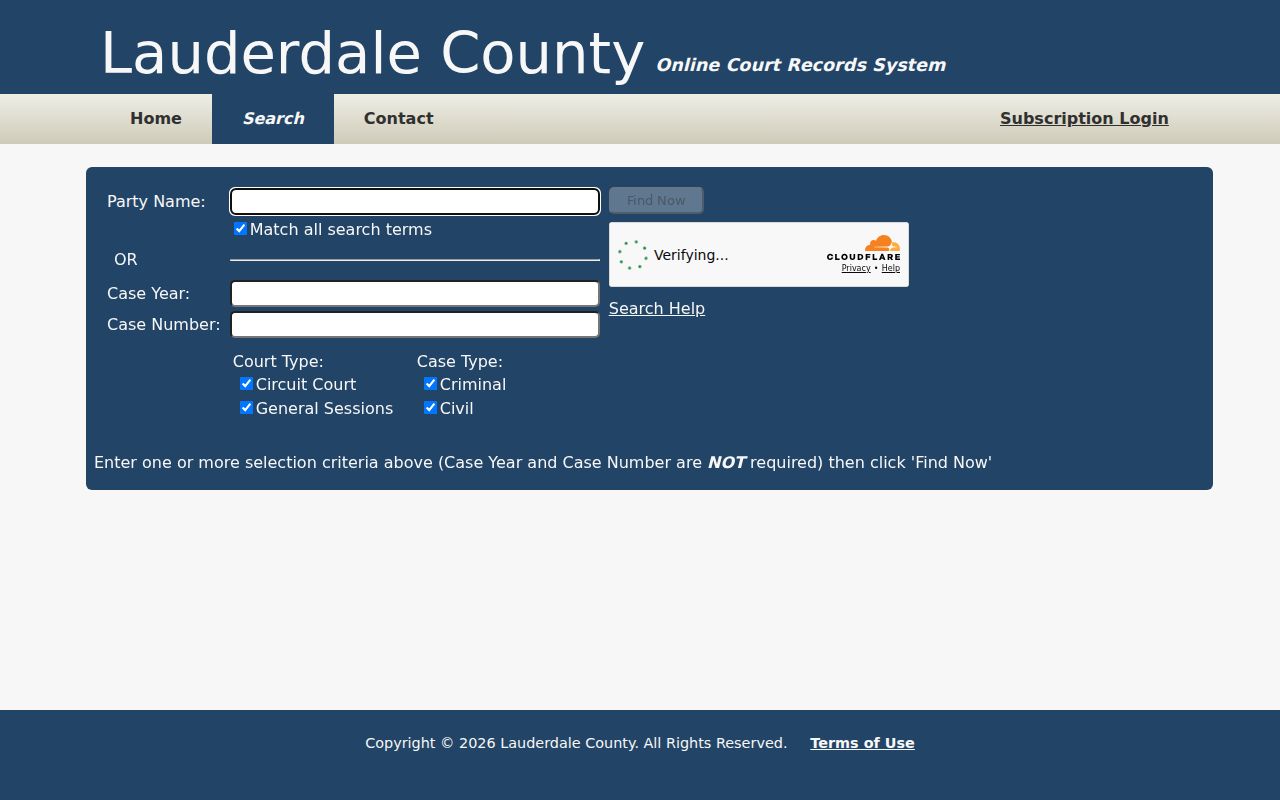
The form confirms the public Lauderdale County case lookup spans Circuit and General Sessions. Each splits into criminal and civil types. Keep all four boxes checked only when the right office is a mystery. Choosing Circuit plus Civil keeps unrelated General Sessions criminal rows out of the set. Unsure of case type? Search both, but hold onto a known year or number.
County vs Statewide Case Search
No statewide public trial search replaces Lauderdale TNCRTInfo. Public Case History handles appeals in the Tennessee Supreme Court, Court of Appeals, and Court of Criminal Appeals. Pick the tool by court, not by whether a page says state or county.
| Tennessee Public Case History | Lauderdale TNCRTInfo |
|---|---|
| Appellate cases only | Indexed Circuit and General Sessions cases |
| Overview, Milestones, Parties, and History | Party/reference, year, final number, and court office |
| Best for an appeal or appellate disposition | Best for a known covered trial matter |
Federal cases live in PACER and the Case Locator. Chancery, probate, juvenile, and municipal files stay with separate custodians. A cross-system name search can still miss a case with the right name.
When Lauderdale Cases Are Not Indexed
A no-result screen is not a dead end. It only means those filters matched no public row in the Lauderdale County docket index. Adjust the search. Try a different court or case type, a new filing year, or the final segment of the case number. With a name, check the spelling first. The portal also broadens long terms in ways that can muddy the results.
Still nothing? Route the question to a live clerk. Clerk & Master Minnie Stowe keeps Chancery and probate-related material; call (731) 635-1941. Rachel Jackson's office handles juvenile and probate work at (731) 635-3505. Expect firm limits on juvenile records there. Gates, Halls, Henning, and Ripley each run their own municipal clerk's office. Older paper files, sealed matters, expunged cases, and data never supplied to the vendor can all sit outside the docket index, so a missing row never proves a record does not exist.
Lauderdale Clerk Contact Is a Fallback
The portal's court-office contact selector gives an official route from the online Lauderdale County docket straight to the clerk responsible for the record.
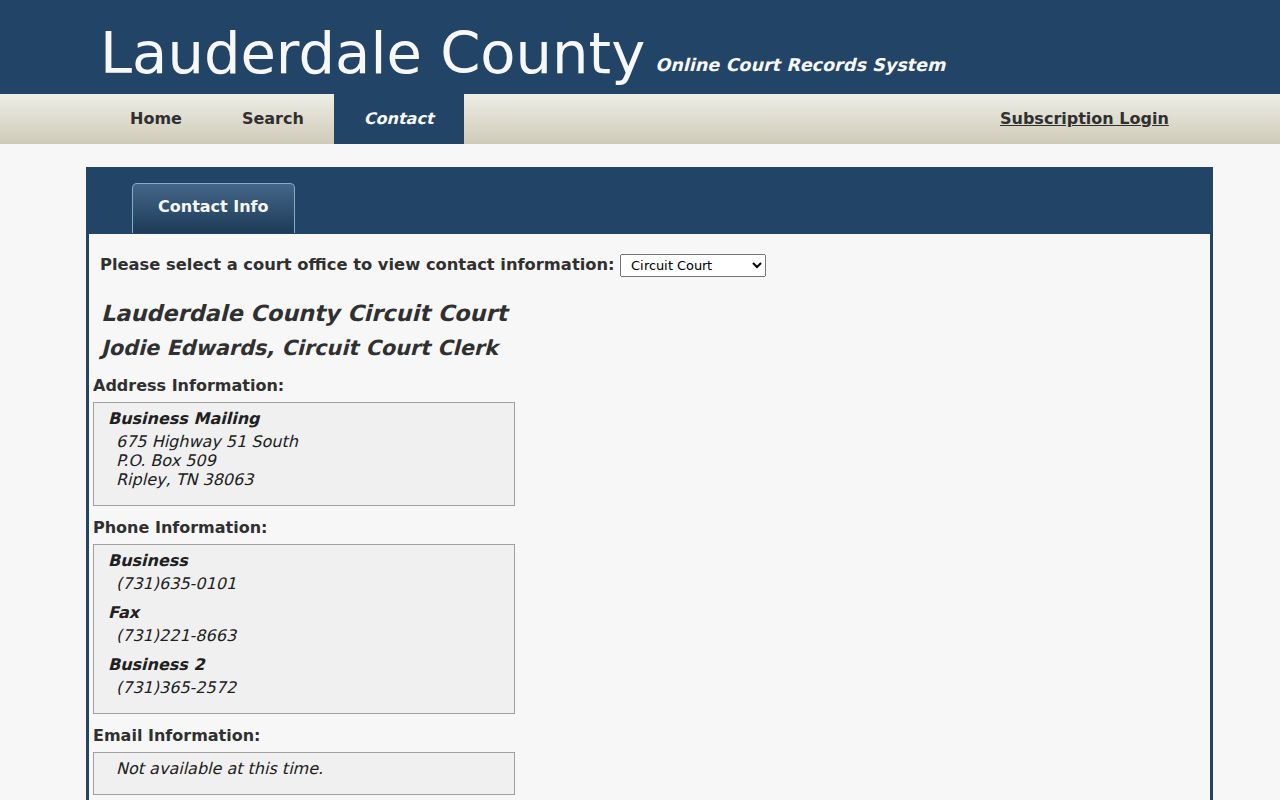
The selector points you to the right fallback. Name the office first. Then ask that clerk to confirm the case or record exists.
Circuit Court Clerk Jodie Edwards serves Circuit and General Sessions from the Justice Complex at 675 Highway 51 South, Ripley; call (731) 635-0101. Have details ready. Give the court, the case type, the year, and the final number if you know it, plus a party or case reference and a date range. State what you want. Inspection, a plain copy, and certification are different requests. When an online Lauderdale County docket search fails, ask the clerk about public-terminal access too.
Restricted Cases and Access Rules
Tennessee Supreme Court Rule 34 opens most court records to the public. Not all of them, though. Statutes, sealing orders, protective orders, and other rules can make a record nonpublic. Juvenile records carry special limits. Even when index data stays public, sensitive family or probate papers may be restricted or redacted at the document level.
An expunged matter may simply not appear. Drafts and deliberative material are different. Internal case-management files never count as public docket entries either. If a clerk withholds a record, ask which rule or order controls access. No portal can hand out access reserved for a party, counsel, an agency, or someone the court has authorized.
Use a Lauderdale County docket for what it does well. Track a case, read the filings, confirm a hearing date, or dig into court history. But verify anything important with the originating court. When a status or outcome truly matters, get the actual order.