
Searching Lauderdale County Criminal Dockets
Start with the Lauderdale County Online Court Records System for an indexed local criminal case. The portal lets you pick a court and a case type. Circuit Court is one choice, and it serves as the main felony trial path. General Sessions is the other. It handles limited criminal matters and preliminary stages as local law permits. Pick Criminal as the case type.
A full party name works best when you have one. Case Year refers to the year the case was filed. That may not match the arrest, the plea, or any later stage. Is your number already formatted? Then type in only the digits that follow the last hyphen. Term expansion can widen a Lauderdale County docket search. Check the court, year, and other visible fields before assuming a match.
- Open the Lauderdale portal and select Criminal.
- Choose Circuit Court or General Sessions.
- Enter the full name, filing year, or final numeric segment.
- Review the result columns and open the matching reference.
- Confirm key entries or request a copy from the clerk.
Lauderdale Criminal Portal Choices
The portal keeps the court split simple. Its official court-type view lists just two search choices: Circuit Court and General Sessions. Lauderdale County routes its criminal docket lookups through those courts.
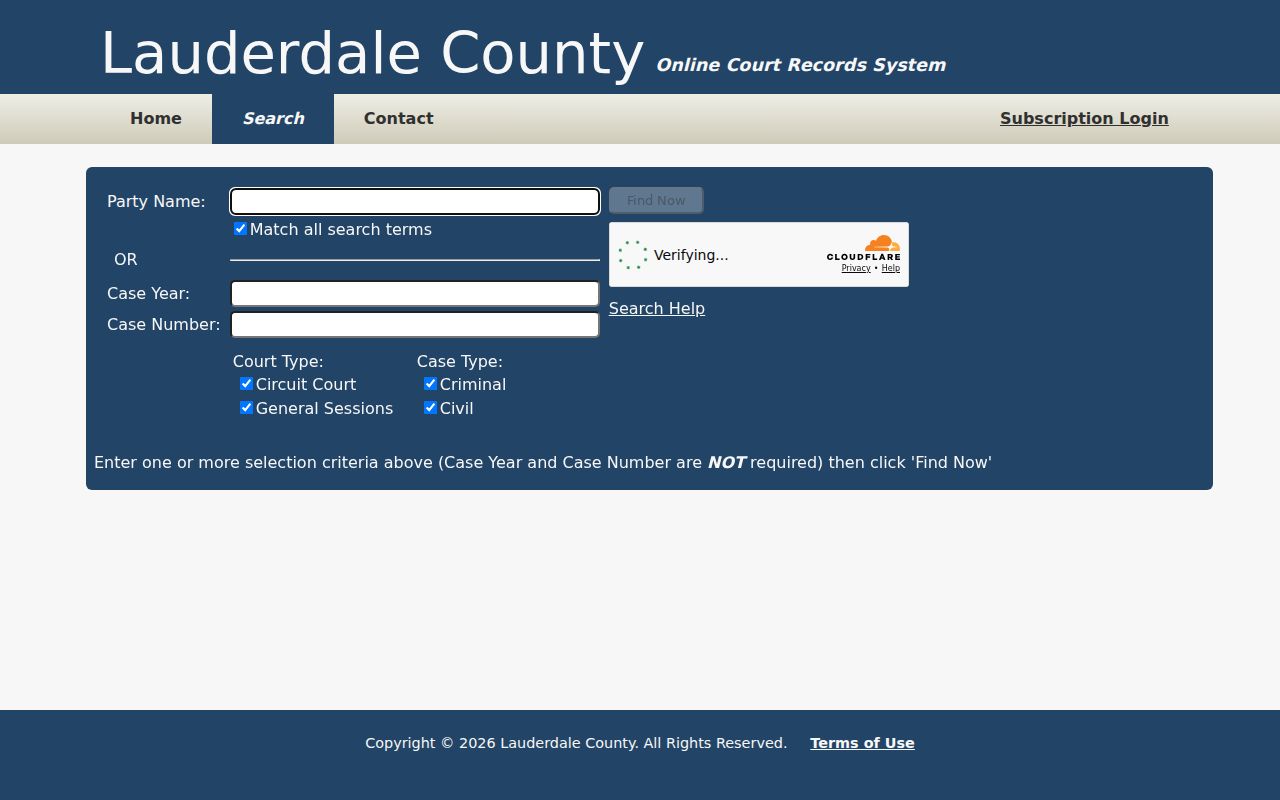
That short list carries real weight. An empty result does not rule out a municipal, juvenile, federal, sealed, or expunged matter. It also guards against a common mistake in a Lauderdale County docket search: picking General Sessions just because an event happened there, when the case later moved to Circuit Court.
Inside a Lauderdale Criminal Docket
Think of a docket as a running chronology, not the whole evidence file. The fields here follow official portal and state vocabulary rather than a worked example. Every Lauderdale County criminal docket entry reflects what the clerk logged, in order.
| Case reference | The identifying reference; use the digits after the last hyphen in the Case Number field. |
|---|---|
| Case year | The original filing year, not necessarily the arrest or disposition year. |
| Court and type | Circuit or General Sessions paired with Criminal. |
| Settings | Hearings, arraignment, preliminary stages, trial dates, resets, or continuances. |
| Disposition | A plea, trial result, dismissal, transfer, or diversion label, subject to the order. |
Some Lauderdale County docket entries point to paper files or orders you cannot pull up online. When the wording of an entry leaves you unsure, ask the clerk for the docket entry itself or the document behind it. A certified copy is clerk-certified proof, while the free index works only as a search aid.
Lauderdale Criminal Counts Explained
For July 2023 through June 2024, the AOC published a fiscal-year report covering filings and dispositions. Lauderdale County reported 712 filed counts and 866 disposed counts. Remember, these are counts. They are not unique cases or people. A disposition can clear a charge filed in an earlier period, so the totals are not a same-year clearance rate.
Probation violation led all filing groups in the Lauderdale County criminal docket. Assault came next, with 97 filings and 122 dispositions. Drugs logged 73 filings and 82. One DUI filing sat against 19 dispositions, a gap that reflects the reporting window and older pending counts rather than any sudden shift in conduct.
How a Lauderdale Criminal Case Moves
A Lauderdale criminal docket grows as a case moves. No two cases follow the same path. General Sessions may record an initial appearance or a preliminary hearing. If a felony is indicted, the case proceeds in Circuit Court. Arraignment covers the charges. It also covers the defendant's rights and plea posture. Later pretrial settings may handle motions, scheduling, or a proposed resolution.
Docket flow: Charge Filed › Preliminary Stage › Indictment › Arraignment › Pretrial › Plea or Trial › Disposition
A continuance or reset tells you one thing: the setting moved. Nothing was dismissed. A charge on the docket is still just a charge, not a conviction, so check with the clerk for the newest court date rather than trusting a saved result that may be stale.
Lauderdale Criminal Disposition Labels
The state report sorts Lauderdale criminal outcomes into buckets: acquittal, conviction after trial, dismissal or nolle prosequi, guilty pleas, and diversion. Nolle prosequi simply means the prosecutor dropped the charge for now. The label never tells you why. Diversion works differently. Its effect hinges on the order entered and the law behind it.
- Dismissal or nolle prosequi
- A category that should not be assigned a reason without the record.
- Guilty plea
- The report separates pleas as charged and to lesser charges.
- Acquittal
- A not-guilty outcome after adjudication, distinct from dismissal.
- Diversion
- A special disposition whose terms appear in the order.
Lauderdale County's totals break down as 365 dismissal or nolle prosequi counts, 217 pleas as charged, 66 pleas to lesser charges, 153 trial convictions, 53 diversions, and 12 acquittals. No figure points to any one person's case.
Courts Holding Lauderdale Criminal Dockets
Circuit Court Clerk Jodie Edwards holds the Lauderdale County Circuit records and backs the Circuit and General Sessions portal. The office sits at 675 Highway 51 South, Ripley, TN 38063. The contact panel lists (731) 635-0101, P.O. Box 509, and fax (731) 221-8663. Ask about requirements before mailing a request.
Municipal dockets live with the clerks in Ripley, Halls, Henning, and Gates. Juvenile matters follow restricted procedures. Federal criminal cases go through Western District PACER. Tennessee Public Case History covers appeals rather than Lauderdale trial cases. Prosecutor and defender offices cannot replace the clerk as the source of record.
Missing Lauderdale Criminal Search Results
A dead end in a Lauderdale County criminal docket search usually has a simple fix. Check the court, the case type, the year, and the spelling of the name. Check the last digits of the case number too. A broad name search works better once you add the filing year or the exact number.
Still nothing? Call the Circuit Court Clerk. Ask whether the case sits in Circuit Court or General Sessions. Then think about other venues. A Lauderdale County city court, juvenile court, federal court, or an appeal might hold it. Sealed or expunged matters simply will not appear. The clerk's Subscription Login is separate from the free docket search, though the local office publishes no terms or price for it, and paying for it does not guarantee a way around a public limit.
No result is not proof of no case. It may reflect the wrong court, another year, an old paper record, or a lawful restriction.
Sealed Lauderdale Dockets and Public Access
Tennessee Supreme Court Rule 34 gives the public a right to inspect court records. The rule carves out exceptions, though. A statute can keep a record out of ordinary public access. So can a seal, a protective order, another rule, or state law.
Juvenile records face extra limits under Tennessee Code section 37-1-153. Expunction goes through the originating court under section 40-32-101. Drafts and internal deliberative papers do not count as public docket records either. Before you request anything, know the court. Know the year or case number and the document too. Decide whether you want inspection or a plain or certified copy.
Access rule: Public access does not cancel a statute, seal, protective order, redaction duty, or juvenile restriction.
Lauderdale Criminal Docket Access Channels
For a Lauderdale County criminal docket online, TNCRTInfo is the starting point. Prefer the phone or the counter? That work goes through the Circuit Court Clerk. The clerk's office also handles mail and fax requests. You should confirm the submission rules before sending anything. Public Case History covers appeals only. PACER serves the federal side. Municipal clerks hold city records. Juvenile cases move through their own authorized process.
Need more than an index? Ask to inspect the record, get a plain copy, or order a certified copy. The clerk sets no published copy-fee schedule for Lauderdale criminal files. So request an estimate up front. The county case lookup instructions walk through the wider name and case number workflow.
Lauderdale Criminal Record Requests
A clear, focused request gets better results from the Circuit Court Clerk. Say which court holds the Lauderdale County record, Circuit Court or General Sessions. Mark the case type as Criminal. Give the party name, the filing year, and the case number if you have it. Then point to the exact docket entry, order, or filed paper you need. State whether you want inspection, a plain copy, or a certified copy. Ask how the office can deliver it.
Older files can take clerk research even when newer cases sit in the online index. For a mailed or faxed docket request, include your return contact information. A listed fax number is not a promise that every request gets accepted that way. So call first. Ask whether identification, Tennessee citizenship, advance payment, or in-person pickup applies to your specific record. One request for an existing court docket entry works far better. Asking staff to build a fresh report across unrelated cases rarely pays off.